Noninvasive LCM · Wellbore Stabilisation
Noninvasive LCM · Wellbore Stabilisation
Liquid Bio Casing
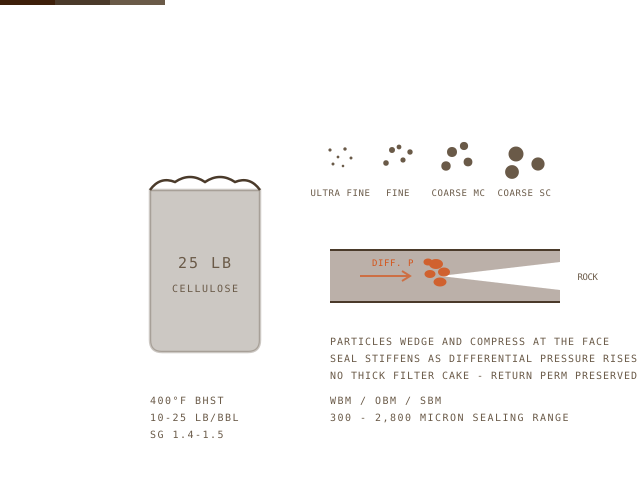
Liquid Bio Casing is a cellulose-derived, insoluble bridging and sealing agent graded into four cuts. Its particles are compressible rather than brittle: under differential pressure they deform and interlock across a pore throat or fracture mouth, and the resulting seal stiffens as the pressure across it rises. That behaviour is what separates it from rigid mineral LCM, which either enters the aperture or does not.
Because the seal forms at the formation face rather than as a thick internal cake, filtrate and solids are held out of the rock, and the material does not measurably alter mud rheology at normal treatment rates. A practical consequence worth knowing: API fluid-loss numbers understate its effect. It works by preventing a thick cake from forming rather than by reducing filtrate through one, so a bench fluid-loss test is a poor predictor of how it will perform against differential sticking downhole.
The fine cuts are added to the active system and circulated to pre-treat known trouble zones ahead of drilling them. The coarse cuts are mixed as pills and spotted against losses already underway. The two are routinely run together, the fine grade sealing the matrix and microfractures while the coarse grade bridges the wider apertures.
Because the seal forms at the formation face rather than as a thick internal cake, filtrate and solids are held out of the rock, and the material does not measurably alter mud rheology at normal treatment rates. A practical consequence worth knowing: API fluid-loss numbers understate its effect. It works by preventing a thick cake from forming rather than by reducing filtrate through one, so a bench fluid-loss test is a poor predictor of how it will perform against differential sticking downhole.
The fine cuts are added to the active system and circulated to pre-treat known trouble zones ahead of drilling them. The coarse cuts are mixed as pills and spotted against losses already underway. The two are routinely run together, the fine grade sealing the matrix and microfractures while the coarse grade bridges the wider apertures.
Available grades:Ultra Fine PZT-LBC-UFFine PZT-LBC-FCoarse MC PZT-LBC-CMCCoarse SC PZT-LBC-CSC
Appearance
Tan granular, free-flowing powder
Temperature Range
Up to 400°F (204°C) BHST
Typical Concentration
10-25 lb/bbl (28.5-71.3 kg/m³)
Specific Gravity
1.4-1.5
Bulk Density
33.09 lb/ft³ (530 kg/m³)
Absolute Volume
0.0799 gal/lb (0.6671 L/kg)
Sealing Range
Up to 300 microns (fine) - up to 2,800 microns (coarse)
Compatibility
WBM, OBM and SBM systems
Full TDS available on request, contact sales@petriz.co
form
Tan granular, free-flowing powder - four graded cuts
application
Seepage and Severe Loss Control · Wellbore Stabilisation · Differential Sticking Prevention
compatibility
Water-Based, Oil-Based & Synthetic-Based Mud Systems
packaging
25 lb sacks · bulk on request
Rates shown are indicative; actual dosage depends on temperature, mud weight, and application conditions.
Available Documentation
TDS - Technical Data SheetSDS - EN · ES · PTCOA - Certificate of Analysis
Request Full Documentation PackResponse within 24 hours · sales@petriz.co
Use Cases & Applications
- Pre-treating the active system ahead of depleted sands and mechanically weak formations
- Curing partial to severe losses as a spotted pill
- Preventing differential sticking across permeable and depleted intervals
- Sealing microfractures and highly permeable formations without a thick filter cake
- Wellbore strengthening ahead of logging runs and casing runs
- Cavernous and vuggy carbonate losses using the coarse SC cut
Pros
- Does not measurably alter mud rheology at normal treatment rates
- Compressible particles seal more effectively as differential pressure increases
- Preserves return permeability - the seal forms at the face rather than invading the matrix
- Reduces torque and drag by acting as a solid lubricant
- Coarse cut passes a 1/4 inch (6,350 micron) dry screen, so it will not block bit jets or mud motors
- Fine cut is fine enough to pump through MWD and downhole tools
- Runs in water-based, oil-based and synthetic systems without reformulation
Cons & Limitations
- Not acid-soluble - like other cellulose and nut-shell LCM it clears mechanically rather than by acid wash
- Solid LCM should be limited when pumping through small orifices: liner hangers, stage collars, poppet-type float collars and casing shoes
- Bottom plugs are not recommended when pumping solid LCM
- Bench fluid-loss testing understates field performance, so it cannot be screened on API fluid loss alone
Ultra FinePZT-LBC-UF
The finest cut. Sized for pore-throat and microfracture sealing in tight and highly permeable formations where the fine grade is coarser than the aperture. Run continuously in the active system. Particle-size distribution on request.
FinePZT-LBC-F
Seals fractures and pore throats up to 300 microns. The general-purpose system additive: circulated in the active mud to stabilise mechanically weak formations, seal depleted sands and prevent seepage before losses start. Fine enough to pump through MWD and downhole tools.
Coarse MCPZT-LBC-CMC
Coarse cut for curing losses encountered while drilling, normally spotted as a pill alongside the fine grade rather than run continuously. Interlocks and swells to form a surface plug that becomes more effective as differential pressure rises.
Coarse SCPZT-LBC-CSC
The widest cut, for large cavernous losses - vugs, fractured carbonates and mixed limestone, where finer grades pass straight through the aperture. Seals fractures up to 2,800 microns and passes a 1/4 inch (6,350 micron) dry screen.
All grades ship under the same product family, contact sales@petriz.co for grade-specific TDS/SDS.
Response within 24 hours
Product Tags
Noninvasive LCMWellbore StabilisationCelluloseSeepage ControlDifferential StickingSDS: EN · ES · PT